When an investor sees a project on the platform, they want to know: has someone checked it, or is it just an ad? Kyrgyz Invest is an information and analytics platform, not a broker: we do not accept money and do not promise returns. But the projects that make it into the catalogue go through selection and vetting. In this article we honestly explain how we vet projects, what this vetting gives the investor and, just as importantly, what it does not guarantee. For investors who want to understand what lies behind a project listing.
Why projects need vetting
Most investor losses are not caused by fraud but by the fact that a project could not withstand scrutiny from the outset: there were no figures, documents or a realistic plan. Preliminary selection screens out some such projects before the investor spends time on them. This does not remove the risk entirely, but it makes the market more transparent. We covered the logic of a self-check in detail in the article how to check an investment project.
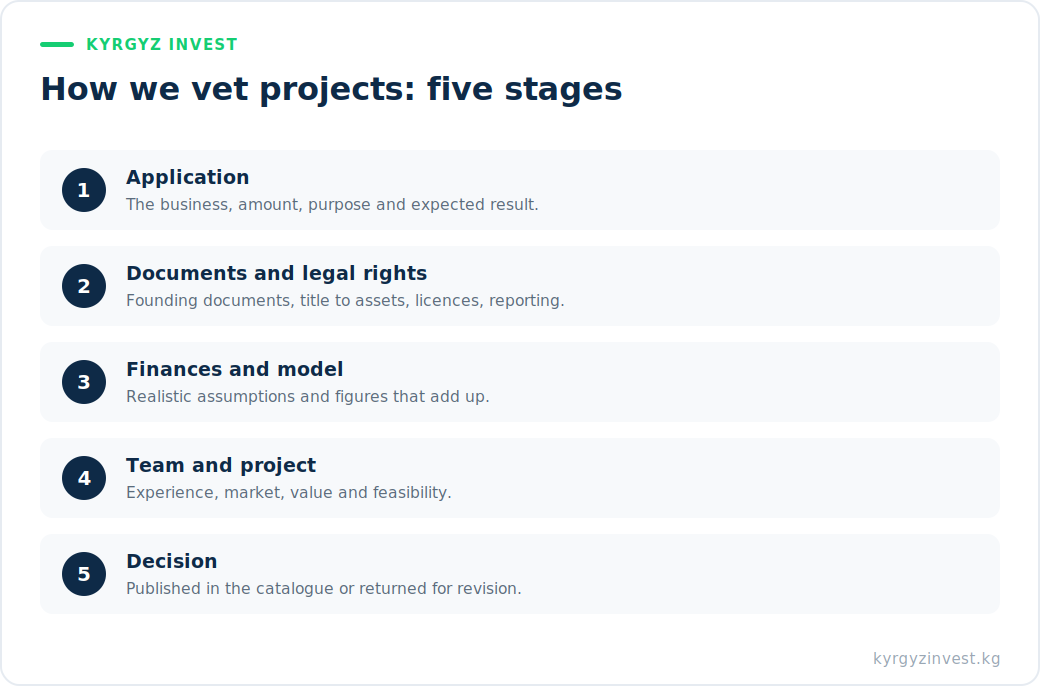
How we select and vet projects: five stages
1. Application
The project submits an application and basic data: what the business is, how much is needed, for what, and what result is expected. Even at this stage you can see how well the owner understands their project.
2. Documents and legal rights
We check the founding documents, title to assets, licences and reporting. If there are problems on the legal side, the project does not proceed without resolving them.
3. Finances and model
We analyse the financial model: whether the assumptions are realistic, whether the figures add up, whether a return is visible. Inflated or unjustified expectations are a reason for revision.
4. Team and project
We look at the experience and reputation of the team and at the essence of the project itself: whether there is a market, what the value is and how feasible it is. An investor invests in people no less than in an idea.
5. Decision
Based on the results, the project is either published in the catalogue or sent back for revision with specific comments. Some projects do not pass, and that is normal.
What vetting does not guarantee
Here we are completely honest. Vetting reduces risk but does not remove it. It does not guarantee returns, does not make a project “safe” and does not replace the investor’s own decision. Any business may fail to meet its plan for reasons that are not visible at the start: the market, the team, circumstances. So no one guarantees risk-free income, and our vetting is a filter and a help, not insurance.
How this helps the investor
Vetting saves the investor time: instead of sorting through raw proposals, they see projects that have already passed a basic filter. It increases transparency, because data and documents are attached to the project. And it sets a common language: projects are described to a clear structure. But the investor still does the final in-depth check against their own criteria themselves.
What the investor should do on their side
Our selection is the first level, not the last. Before a deal, the investor should carry out their own check (due diligence): request documents, verify the figures, assess the risks and, if necessary, bring in a consultant or lawyer. We explained what due diligence is in simple terms in a separate article, and we covered the types of risk in the article on investment risks in Kyrgyzstan.
Frequently asked questions
Are all projects on the platform vetted?
Projects in the catalogue go through selection and vetting, but this is not a guarantee of results — it is a basic quality filter.
Does Kyrgyz Invest guarantee returns?
No. The platform is not a broker and does not promise income. Vetting reduces risk but does not remove it.
What exactly is checked?
Documents and the legal side, the financial model and the realism of the figures, the team and the essence of the project.
Does the investor need to check for themselves?
Yes. The platform’s selection is the first filter, not a replacement for the investor’s own check and decision.
What if a project does not pass the check?
It is not published or is sent back for revision with comments. Rejection is a normal part of selection.
Where to go next
The next steps depend on which side you are on.
- For investors: take a look at the project catalogue and refresh the logic in the article how to check an investment project.
- For entrepreneurs: submit a project and go through a diagnostic, to understand what to improve before publication.