
Kyrgyzstan remains one of the few countries in the region where almost all electricity comes from hydropower, while demand is growing faster than new capacity is being added. For an investor, two things are hidden in that picture: a structural deficit that someone will have to close, and a long list of projects looking for capital. This analysis is for private investors, entrepreneurs in the energy sector and foreign funds who want to understand how the energy market of Kyrgyzstan works, where projects take shape and which risks to assess before a deal.
Energy in Kyrgyzstan is a capital-intensive, long-cycle industry where no one promises fast or guaranteed returns. Below we separate facts from open sources from our own conclusions and estimates. Specific figures for generation, capacity and the deficit change from year to year, so before any decision they are worth checking against primary sources: the National Statistical Committee, the Ministry of Energy, OJSC National Electric Grid of Kyrgyzstan and publications by international organisations. The material is general information and analysis, not investment advice.
How the energy market of Kyrgyzstan works
The defining feature of the system is the dominance of water. By various estimates, hydropower accounts for around 90 percent of generation, with the rest coming from coal-fired thermal plants; this is consistent with World Bank data and the statements of the Ministry of Energy. At the same time the technically available hydropower potential is put at roughly 142 billion kilowatt-hours a year, of which only about 10 percent has been developed. The five largest hydropower plants stand on the Naryn River, including the Toktogul plant. Different sources give installed capacity in a range of roughly 3,600 to 4,100 megawatts, and these values should be checked against current publications.
Two further features matter for project economics. Electricity tariffs are among the lowest of the former Soviet states, which stretches out payback without support mechanisms. There is also strong seasonality: demand peaks in winter while the water reserve is limited, so in low-water years the country imports electricity. The market is largely state-owned: generation sits with OJSC Electric Power Plants, the trunk grid with OJSC NESK, and tariffs are set by the relevant authority. That means the main buyer is usually the state side, and its ability to pay feeds directly into the project.
Why the energy sector is a structural opportunity, not easy money
Demand for electricity is rising steadily, and the deficit is officially recognised: in 2023 a state of emergency was declared in the energy sector, in effect from August 2023 through the end of December 2026 (per the president’s press service), because of the electricity shortage. The regime remains in force in 2026, and its status as it approaches expiry is worth confirming through official sources. Rising demand, an acknowledged deficit and untapped potential add up to one conclusion: the country needs new capacity and the modernisation of plants and grids, and that means capital. The state describes the development of the energy sector as a national priority.
Different directions suit different investors: private capital is closer to small hydropower, solar, wind or a stake in an operator; funds, development banks and strategics are closer to large hydropower and infrastructure in a partnership format with the state; Kyrgyzstanis abroad tend to prefer clear projects with a transparent participation structure. Financing for the sector rests heavily on international institutions (the Eurasian Development Bank, the Asian Development Bank, the World Bank), while in large hydropower the participation of partners from Russia and China is under discussion. The sector is not simple, though: projects are expensive, long and sensitive to water, tariffs and currency. No one guarantees risk-free income here.
Main directions for investment
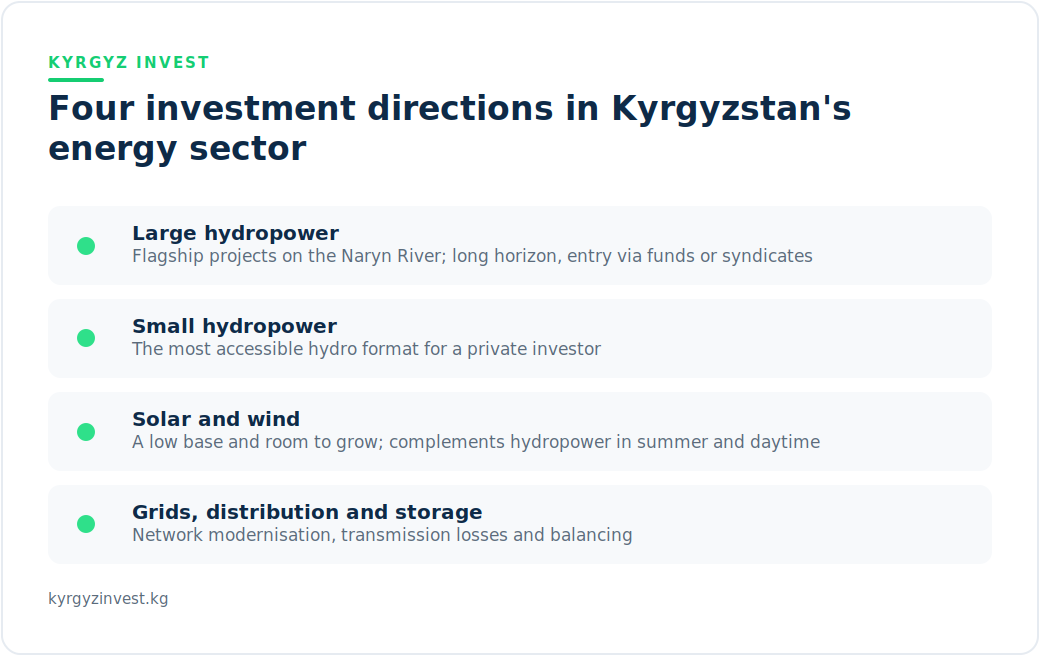
The sector breaks down conveniently into four directions, each with its own entry logic and risk profile.
Large hydropower
The flagship is the Kambarata HPP-1 on the Naryn. According to the Eurasian Development Bank and the Eurasian Fund for Stabilization and Development, the plant could produce on the order of 6,000 gigawatt-hours a year, around 40 percent of the country’s power supply. The Upper Naryn cascade and the reconstruction of existing plants belong here too. This means hundreds of millions of dollars and a long horizon; a private investor usually enters through funds, syndicates or a construction contract.
Small hydropower
The most accessible format for a private investor within hydropower: the mountainous terrain offers many suitable sites. Large players are interested too. For example, in 2024 a structure of the state corporation Rosatom signed an agreement to study small HPPs with a combined capacity of up to 400 megawatts, with the first plant on the Chandalash River.
Solar and wind
The base is still very low, so there is plenty of room to grow, especially as a complement to water: solar and wind cover summer and daytime demand. The first projects are appearing, and the state is building out the rules and the purchase mechanisms around them.
Grids, distribution and storage
A less visible but real field: worn networks and transmission losses, the modernisation of substations and lines, metering, plus storage and balancing. These projects sit closer to infrastructure and often run through partnerships or donor financing.
How the state supports investment in energy
The investor’s main question is simple: who will buy the electricity, and how. The base document is the Law on Renewable Energy Sources No. 49 of 30 June 2022, which, together with the Law on Investments in the Kyrgyz Republic, sets the rules for renewable projects. A key addition came in 2025: Cabinet of Ministers Resolution No. 70 of 14 February 2025 approved the procedure for the guaranteed purchase of electricity from renewable facilities under investment agreements. The Green Energy Fund was named the authorised organisation, and the mechanism covers cases where OJSC NESK cannot pay for the supplied energy from its own funds. These rules were refined again in mid-2025 by Resolution No. 360 of 23 June 2025.
For an investor this is a clearer sales structure: a supply contract and a purchase guarantee reduce the risk of the buyer defaulting. Tariff preferences for a term of up to ten years have also been discussed. Launching a project is a multi-stage procedure: the register, land rights, design and cost documentation, licences, the tariff and payback period, the supply contract, construction and commissioning. An important caveat: the texts of laws and secondary acts change, the wording of guarantees and tariffs is critical, so they need to be checked against primary sources and put through legal review. A purchase guarantee is not a guarantee of the project’s profitability, only an element of the deal structure.
How to read an energy project: the logic on two examples
Specific parameters are always taken from the project file and verified, so we talk about the logic rather than ready-made figures.
A wind farm of around 13.5 megawatts. First you check the resource: are there multi-year wind-speed measurements on the site itself. Then the connection point and terms, the contract and purchase guarantee, the turbine supplier and servicing, land rights, capital costs and the schedule. Wind complements water but is uneven, so the model is built across scenarios.
A small HPP in the Issyk-Kul region. The key question is water: river-flow data over several years, seasonality, minimum levels. Then the construction part, environmental approvals, land and water rights, the purchase contract, the contractor. A small HPP is more predictable than wind but depends on the water level in any given year.
The logic is the same in both cases: a confirmed resource, clear sales, a realistic cost estimate, a vetted contractor and a scenario model. Real projects can be viewed in the project catalogue.
Risks of investing in the energy sector of Kyrgyzstan
Energy is not about the absence of risks but about understanding them. The main groups look like this.
- Tariff and regulatory. Low tariffs cap revenue, and changes to the rules and purchase terms affect the model.
- Hydrological, seasonal and climatic. HPP output depends on the water level; floods, mudflows and landslides can damage structures.
- Sales and payments. The buyer is usually the state; the purchase guarantee through the Green Energy Fund reduces the risk but does not remove it entirely.
- Construction and capital. Long timelines, rising costs for materials and works, delays in commissioning.
- Currency. Equipment and loans are often in foreign currency, while revenue is in som.
- Ageing infrastructure. Old networks raise losses and require investment.
We wrote about the types of risk in a structured way in the article on investment risks in Kyrgyzstan. The principle is unchanged: no one guarantees risk-free income, and the investor’s task is not to avoid risks but to assess them and price them into the deal.
How an investor can vet an energy project
A short but strict checklist helps screen out weak offers.
- Is there a supply contract and a purchase guarantee, on what terms and for how long.
- Have permits, licences and land and water rights been obtained.
- Is the resource confirmed by measurements: wind, flow, insolation, rather than regional averages.
- Who is the contractor and equipment supplier, and what is their experience and servicing.
- Is the financial model built across scenarios, allowing for seasonality, currency and cost growth.
- Have environmental approvals and an impact assessment been completed.
- How is the deal structured: equity, debt or a mixed format.
We cover the vetting method in due diligence explained and in the investor guide.
Sources and a note on the data
The estimates in this material draw on open publications, including the World Bank, the Eurasian Development Bank, international energy statistics (IRENA, Ember), as well as the legal acts of the Kyrgyz Republic (the Law on Renewable Energy Sources No. 49, Cabinet of Ministers Resolution No. 70). Specific figures for generation, capacity, the deficit and project timelines change and require checking against current data from the National Statistical Committee, the Ministry of Energy and the relevant companies. Conclusions and estimates are separated from facts and are our interpretation, not statements by state bodies.
Frequently asked questions
Can a private investor invest in the energy sector of Kyrgyzstan?
Yes. Direct entry is most often possible through small hydropower, solar and wind projects, or through a stake in an operating company. Into large hydropower, private capital usually enters via funds, syndicates or the construction side.
Which energy source is the most promising?
There is no universal answer, and it would be wrong to call any project the best. Small HPPs have historically been considered one of the most attractive formats, while solar and wind are quickly gaining weight as a complement to water. The choice depends on the site, the resource and the deal structure.
Does the state guarantee the purchase of electricity from renewable projects?
Since 2025 a guaranteed-purchase mechanism has been in place through the Green Energy Fund under investment agreements. This reduces the risk of the buyer defaulting, but it is not a guarantee of the project’s profitability, and the terms should be checked against the primary source.
What are the main risks in energy?
Tariff and regulatory, hydrological and seasonal, sales and payment risk, construction and currency risk. All of them are manageable if assessed in advance and priced into the model.
Where should an investor start?
By looking at real projects in the catalogue, vetting an interesting project against the checklist, and going through a diagnostic to assess the resource, sales, cost estimate and risks soberly.
Where to go next
If you are considering the energy sector of Kyrgyzstan as a direction for investment, three steps make sense next.
- Look at the catalogue of investment projects, including in energy.
- Refresh the context in the overview of the investment climate in Kyrgyzstan and the guide on investing in Kyrgyzstan.
- Assess a specific project with us: request a project diagnostic, and we will go through the resource, sales, cost estimate and risks on the merits.
Part of our guide: Invest in Kyrgyzstan: a 2026 guide for foreign investors and funds.