
Agriculture feeds the country and at the same time remains one of the most under-invested sectors of the economy. Agriculture and livestock in Kyrgyzstan mean vast pastures, millions of farms and rising exports of fruit, berries and meat, yet alongside that sit low processing and modest productivity. For an investor, that combination signals potential: demand for quality food is growing both inside the country and among its neighbours, while supply still lags. This is a large study for private investors, agribusiness entrepreneurs and foreign funds: how the agricultural market works, what directions exist, how to read an agro project and which risks you will need to assess.
A word on the data first. The figures below rely on open sources (the Ministry of Agriculture, the National Statistical Committee, trade reviews) and may differ by year, so they are worth checking against current publications. We separate facts from conclusions and we do not promise returns: in agriculture, returns depend on the harvest, prices and the market. The material is general information and analysis, not investment advice.
Why agriculture is a base of the Kyrgyz economy
Agriculture provides on the order of 13 to 15 percent of GDP and employs a large share of the population, though estimates of the exact share vary by source and methodology. By various estimates, between 20 and more than 30 percent of those working are in the sector, and most residents still live in rural areas. Within output, roughly half comes from crop farming and around 47 percent from livestock. The country has more than 9 million hectares of pasture, which historically shaped its strong sheep and cattle breeding.
An important feature is fragmentation. The overwhelming share of output is produced by small peasant farms. That is a plus for employment but a minus for quality, standardisation and reaching export markets: a large buyer struggles to work with thousands of small suppliers. Hence the first conclusion for an investor: value is created where scattered raw material is turned into a standardised product.
What makes agriculture attractive to an investor
The main driver is demand for food among the neighbours. Kyrgyzstan is part of the Eurasian Economic Union, which means access to the markets of Russia and Kazakhstan without customs barriers; interest from China, Turkey and the Middle East is growing. According to industry reviews, the backbone of agricultural exports is beans, dairy products and butter, nuts, fruit and vegetables, and meat; the key markets are Russia, Kazakhstan, Uzbekistan, Turkey and China. Exports of fresh fruit and vegetables have grown noticeably over the past decade.
The second driver is the gap between raw material and processing. The country exports a lot of raw produce and little finished product, so processing, storage and packaging are a field with high added value. The third is import substitution and food security: part of the food supply is still imported. At the same time, livestock productivity lags developed countries because of genetics, feeding and technology, and that too is a point of growth, not only a problem.
Main directions for investment
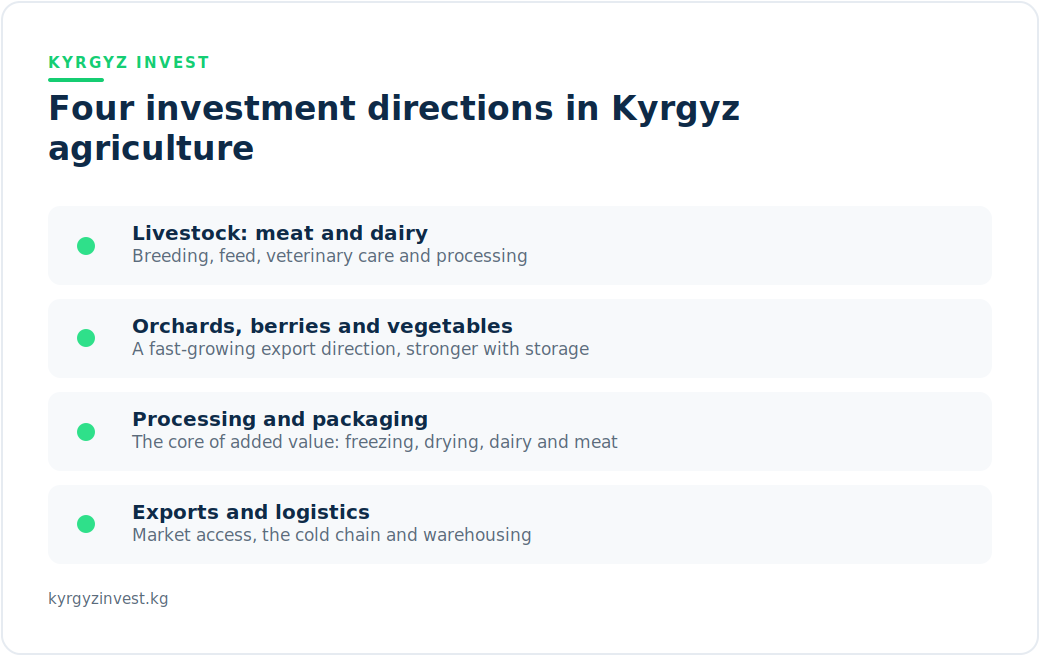
Agriculture breaks down conveniently into four directions, each with its own economics and risks.
Livestock: meat and dairy
The most traditional direction. In meat production, beef and mutton dominate; in dairy, almost everything is cow’s milk. The growth points are improved breeds, feed, veterinary care and processing (meat processing, dairy plants, cheeses). One example of project logic is a breeding centre for meat sheep breeds such as the Edilbai: a hardy fat-tailed breed that yields meat and fat and is in demand in the region.
Orchards, berries and vegetables
A fast-growing export direction. Fruit, berries and vegetables sell well in Russia, Kazakhstan and beyond, especially with proper storage and packaging. Examples of project logic include horticulture and cherry projects (such as the agri-export project Tattuu Alcha) and greenhouse strawberries (the berry project): greenhouses produce out-of-season crops and stable quality, which buyers value.
Processing and packaging
The core of added value. Freezing berries, drying fruit, processing milk and meat, and packaging turn cheap raw material into a product with an export price. Controlled production belongs here too, for example a trout farm using recirculating aquaculture systems (RAS): such a format gives predictable quality and year-round output.
Exports and logistics
Without sales, the rest does not work. Access to the markets of the EAEU, China, Turkey and the Middle East is an advantage, but mountainous terrain, distance from sea routes and periodic delays at borders raise logistics costs. Investment in warehouses, the cold chain and logistics solutions often turns out to be no less important than investment in production itself.
Reading projects: how to read an agro project
Specific parameters are always taken from the project file and verified, so we talk about the logic. Using typical agro projects (meat sheep breeding, horticulture and cherries, greenhouse strawberries, a RAS trout farm), an investor checks several things. First, the resource: land, water, livestock or plantings and their confirmed condition. Second, sales: are there contracts or sales channels, especially for export. Third, processing and storage: how the product is brought to marketable form. Fourth, certification and standards for the target market. Fifth, the team and the contractor. And, without fail, a scenario financial model that accounts for seasonality, prices and losses. Real agro projects can be viewed in the project catalogue.
Risks of investing in agriculture
Agriculture is not about the absence of risks but about understanding them.
- Climate and water. Droughts, frosts and water shortages hit the harvest and feed directly.
- Seasonality and prices. Income is uneven across seasons, and product prices fluctuate.
- Animal and plant diseases. Epizootics and pests can wipe out part of a herd or harvest.
- Quality and certification. Without meeting standards, export markets stay closed.
- Logistics and the border. Higher transport costs and border delays reduce margins.
- Fragmented supply. It is hard to assemble stable volumes of the required quality.
We wrote about the types of risk in a structured way in the article on investment risks in Kyrgyzstan. The principle is unchanged: no one guarantees risk-free income; risks must be assessed and priced into the deal.
How an investor can vet an agro project
A short checklist helps separate a working project from a pretty presentation.
- Are the resource and assets confirmed: land, water, livestock, plantings, equipment.
- Are there sales: contracts, channels, export destinations.
- Are processing and storage covered, including the cold chain.
- Has certification for the target market been completed.
- Who is on the team, and is there industry experience.
- Is the financial model built across scenarios, allowing for seasonality and losses.
- Is there veterinary and phytosanitary control.
We cover the vetting method in due diligence explained and in the investor guide.
Sources and a note on the data
The estimates draw on open publications by the Ministry of Agriculture and Land Reclamation, the National Statistical Committee and reviews of agricultural foreign trade. Specific shares of GDP, output and export volumes, market structure and herd numbers change by year and require checking against current data from primary sources. Conclusions and estimates in the text are separated from facts and are our interpretation, not statements by state bodies.
Frequently asked questions
Is it profitable to invest in agriculture in Kyrgyzstan?
The sector has potential because of rising export demand and weak processing, but returns are not guaranteed and depend on the harvest, prices and the market. What decides it is a vetted project, not the sector as a whole.
Which direction in agriculture is the most promising?
There is no universal answer. High added value comes from processing, storage and exports, while among production the interesting areas are orchards, berries, greenhouse vegetables and meat-and-dairy livestock.
Where does Kyrgyz agriculture export?
The main markets are the EAEU countries (Russia, Kazakhstan), as well as Uzbekistan, Turkey, China and some Middle Eastern countries. Access to the EAEU without customs barriers is an important advantage.
What are the main risks in agro investment?
Climate and water, seasonality and prices, animal and plant diseases, logistics and certification. All of them are manageable if assessed in advance.
Where should an investor start?
By looking at agro projects in the catalogue, vetting an interesting project against the checklist, and going through a diagnostic to assess the resource, sales and risks on the merits.
Where to go next
If you are considering agriculture as a direction for investment, a few steps make sense next.
- Look at the catalogue of investment projects, including agriculture.
- Refresh the context in the overview of the investment climate in Kyrgyzstan and the guide on investing in Kyrgyzstan.
- Assess a specific project with us: request a project diagnostic.
Part of our guide: Invest in Kyrgyzstan: a 2026 guide for foreign investors and funds.