Tourism in Kyrgyzstan stopped being only a summer Issyk-Kul long ago. It is a growing industry with millions of guests, state targets and a large gap between demand and quality supply. For an investor that is a clear opportunity: the flow of tourists is rising, while modern hotels, services and well-considered projects are in short supply. Tourism in Kyrgyzstan is the subject of a large study: how the market works, what directions exist, how to read a tourism project and which risks you will need to assess. The material is for private investors, tourism entrepreneurs and foreign funds.
The figures below rely on open data from the National Statistical Committee and the Tourism Department and may differ by methodology, so before any decision they are worth checking against current publications. We separate facts from conclusions and we do not promise returns: in tourism, returns depend on the season, occupancy and the market. The material is general information and analysis, not investment advice.
Why tourism is a growing sector of Kyrgyzstan
According to 2024 data, more than 3.7 million tourists holidayed in the country, roughly 1.3 times more than a year earlier; by the broader estimates of the Tourism Department the number of guests is higher still, because counting methods differ and the figure is worth clarifying. The contribution of tourism to the economy is put at around 58 billion som, or about 3.8 percent of GDP, against 2.9 percent in 2020. The authorities have stated a goal of doubling the share of tourism in GDP by 2030 and growing the flow by around 10 percent a year.
The main hub is Issyk-Kul: according to statistics, the region has around 2,200 accommodation facilities, and in the resort season hundreds of thousands of people stay there in the organised sector and more than a million in the private one. The main flow comes from the CIS countries (Kazakhstan, Russia, Uzbekistan), while interest from further afield (China, the Middle East, Europe) is growing.
What makes tourism attractive to an investor
The facts are easy to add up: the flow is rising, the state calls tourism a priority, and billions of som are going into the construction of tourism facilities. There is an important signal, though: according to 2024 data, foreign investment in tourism fell noticeably, especially from countries further afield. From that we draw our own conclusion: demand is outpacing quality supply, and the sector has unfilled niches, from modern hotels to services and new locations. But tourism is not easy money: it is seasonal and sensitive to infrastructure and the environment. No one guarantees risk-free income here.
Main directions for investment
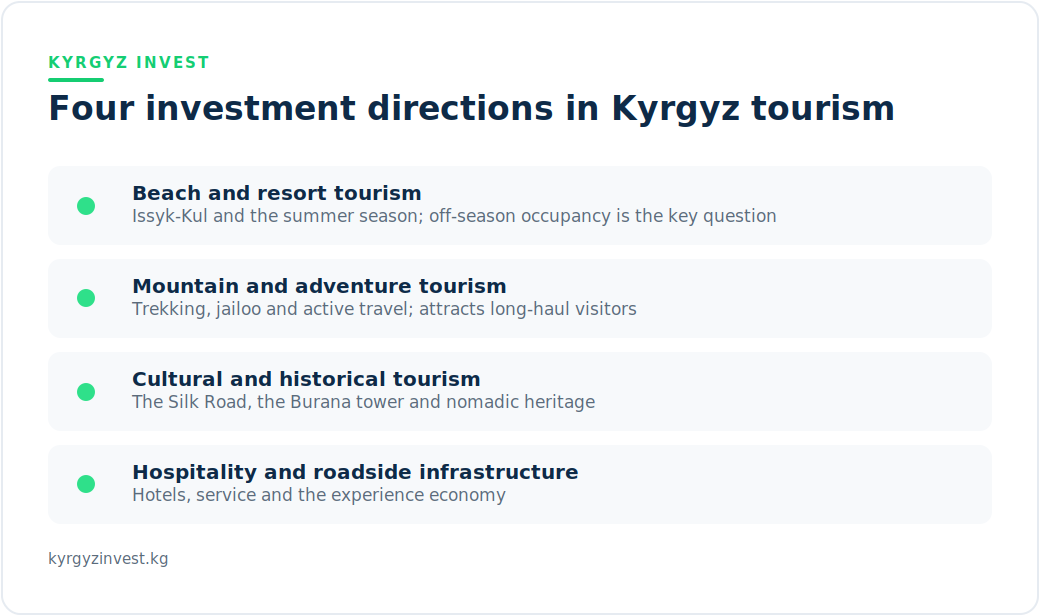
The sector breaks down conveniently into four directions.
Beach and resort tourism
The core of demand is Issyk-Kul and summer holidays: hotels, bases, guest houses, entertainment. The high season is short, so the key question is occupancy outside summer. One example of project logic is resort and recreational projects such as Khan-Salyk.
Mountain and adventure tourism
Trekking, climbing, jailoo (mountain pastures), eco and active tourism. This segment attracts long-haul visitors and depends less on the beach season, but it requires logistics and prepared routes. The ski direction belongs here too.
Cultural and historical tourism
The Silk Road, the Burana tower, the Manas epic, rock carvings and nomadic culture. This is a base for tours, museums and event tourism, especially for guests from China and Europe.
Hospitality, accommodation and roadside infrastructure
Hotels and guest houses, roadside service, transport, cafes and the logistics of experiences. Often it is the service, rather than the attraction itself, that decides whether a tourist returns. Hotel real estate overlaps with the theme of real estate investment in Kyrgyzstan.
Reading a project: how to read a tourism project
Specific parameters are always taken from the project file and verified, so we talk about the logic. Using a resort or service project (for example, a recreational complex such as Khan-Salyk), an investor looks at several things. Location and accessibility: how to get there and what infrastructure is nearby. Seasonality and occupancy: are the assumptions on occupancy realistic and is there a plan for the low season. Capital costs and construction timelines. Land rights and permits. And, without fail, a scenario financial model, because in tourism revenue swings sharply. Real tourism projects can be viewed in the project catalogue.
Risks of investing in tourism
Tourism is not about the absence of risks but about understanding them.
- Seasonality. A short high season and downtime outside it hit revenue.
- Environment and load. Issyk-Kul and nature have limits, and requirements are gradually tightening.
- Infrastructure. Roads, airports and treatment facilities sometimes lag the flow.
- Regulatory change. Building rules and environmental norms can change.
- Demand swings. Dependence on neighbouring markets and the general situation in the region.
- Climate and weather. They affect the length and quality of the season.
We wrote about the types of risk in a structured way in the article on investment risks in Kyrgyzstan. The principle is unchanged: risks must be assessed and priced into the deal.
How an investor can vet a tourism project
- Are the location, land rights and permits confirmed.
- Are the assumptions on occupancy and seasonality realistic.
- Is there a revenue plan outside the high season.
- What infrastructure is nearby: roads, water, electricity.
- Capital costs, the cost estimate and the contractor.
- Is the financial model built across scenarios.
We cover the vetting method in due diligence explained and in the investor guide.
Sources and a note on the data
The estimates draw on open data from the National Statistical Committee and the Tourism Department. The number of tourists, the share of tourism in GDP and investment volumes change and depend on the counting method, so they require checking against current publications. Conclusions and estimates in the text are separated from facts and are our interpretation, not statements by state bodies.
Frequently asked questions
How many tourists come to Kyrgyzstan?
According to 2024 data, more than 3.7 million people holidayed in the country. By the broader estimates of the Tourism Department the number of guests is higher, because counting methods differ.
Where to invest in tourism?
In hotels and services on Issyk-Kul, mountain and cultural tourism, and roadside infrastructure and accommodation in new locations.
What is tourism’s main problem?
Seasonality and a shortage of quality infrastructure and modern service against a rising flow of guests.
What are the risks in tourism projects?
Seasonality, environmental limits, infrastructure gaps and demand swings. All of them are manageable with a sober assessment.
Where should an investor start?
By looking at tourism projects in the catalogue, vetting an interesting project against the checklist, and going through a diagnostic.
Where to go next
If you are considering tourism as a direction for investment, a few steps make sense next.
- Look at the catalogue of investment projects, including tourism.
- Refresh the context in the overview of the investment climate in Kyrgyzstan and the guide on investing in Kyrgyzstan.
- Assess a specific project with us: request a project diagnostic.
Part of our guide: Invest in Kyrgyzstan: a 2026 guide for foreign investors and funds.