Many Kyrgyzstanis live and work abroad but want to stay connected to the country and invest back home. The reasons vary: to earn, to support the country’s development, to take part in real projects. The main barriers are clear too: distance and the question of trust. In this article we look at why the diaspora invests at home, what is realistic, how to do it sensibly and what contribution it makes. A full step-by-step order for entering remotely is in a separate guide on how to invest in Kyrgyzstan from abroad. The material is general information and analysis, not investment advice.
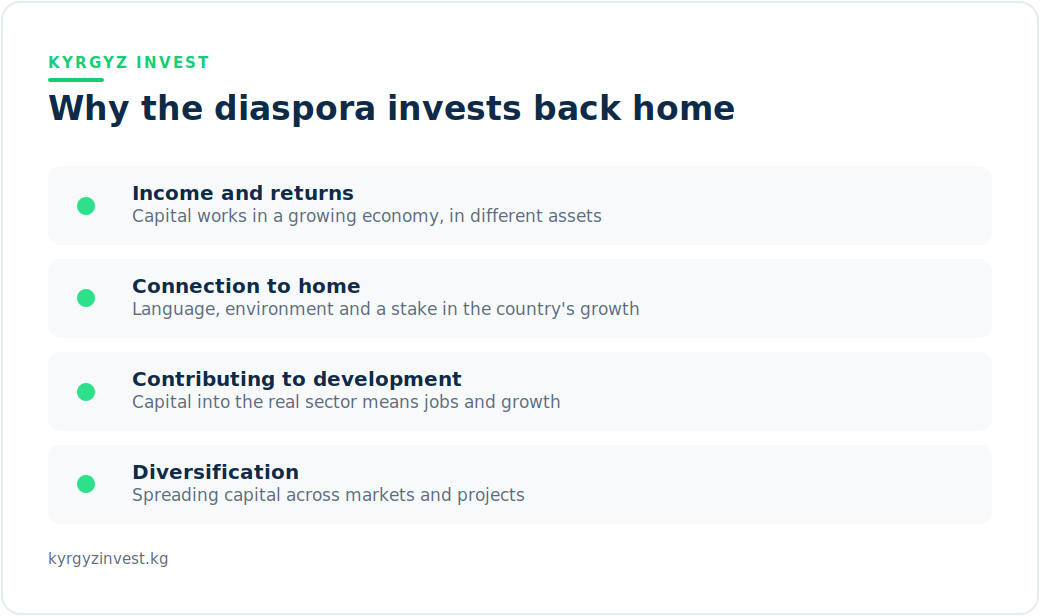
Why the diaspora invests back home
Here the rational and the personal meet. Rationally, it is income and diversification: part of the capital works in a country with a growing economy and in assets different from those in the country of residence. Personally, it is the connection to home, an understanding of the language and environment, and the wish to take part in development: new projects mean jobs and economic growth. This mix of motives is what makes investment a theme that feels especially close for the diaspora.
What is realistic and what is not
It is realistic to take part remotely through equity or debt, without coming to every stage. It is realistic to vet a project at a distance and to formalise the deal officially. What does not work is investing on trust and emotion, without checking. A connection to home should not switch off common sense: a project needs to be studied as strictly as any other investor would study a market unfamiliar to them.
How to take part from abroad
In short, the path is this: choose a project, vet it remotely, structure the deal and bring in the funds. We covered each of these steps, with the detail on documents, structure and transferring money, in the guide on how to invest from abroad. The method for vetting the project itself we put together in the vetting guide.
Trust and vetting: the key point for the diaspora
This is the key section. An emotional connection to the country, relatives or acquaintances in a project, is not a substitute for vetting, and is sometimes even a risk factor, because saying no is harder. So the rules are the same: check the legal entity and documents, the financial model and sales, and formalise the deal officially and through a notary. It helps to have a trusted party on the ground, whether a platform, a lawyer or a representative who looks at the details in person.
Contribution to the country’s development
Diaspora investment has a public meaning too. Capital that comes into the real sector means new production, farms, services and jobs. This is not charity but an investment that also helps the country’s economy. Many in the diaspora value exactly this double return: income for themselves and development for home.
Risks and how to account for them
The main risks of taking part from afar are incomplete information, distance and bad-faith schemes. They are reduced by careful remote vetting, bringing in a local specialist, a correct legal structure, transferring funds to the company’s account for the deal rather than to personal accounts, and spreading investment across projects. And, as always, no one guarantees risk-free income.
Where to start
Look at the project catalogue, and if you want help with selection and remote vetting, start with a free diagnostic. We put the general picture of investment in the country together in the guide.
Frequently asked questions
Can a Kyrgyzstani abroad invest back home?
Yes. You can take part remotely through equity or debt, with the deal formalised officially through a project company. A connection to the country is a plus, but the project must be vetted strictly.
How do you vet a project while living abroad?
Request documents, hold video meetings, bring in a local lawyer and finance specialist, and run the project through a checklist. For large sums, it is better to entrust the vetting to specialists.
What participation formats are available to the diaspora?
The same as for everyone else: a stake in the project or a loan, sometimes mixed formats. The choice depends on goals and risk appetite.
Is it safe to invest from abroad?
There is no such thing as a fully safe investment. Risk is reduced by vetting, a correct deal structure and transfers to the company’s accounts rather than personal ones.
Where do you start?
By choosing a project and vetting it. It is convenient to start with a free diagnostic, where you get help selecting a project and assessing it before the deal.
Where to go next
Study the step-by-step guide on how to invest from abroad and look at the catalogue. Before the deal, run the project through the vetting guide, and for help start with a diagnostic.