
The state owns large assets in energy, infrastructure, transport and other industries. But the budget is not always enough to modernise and develop them, while private capital and management experience can speed that up. So the theme of the investment readiness of state companies is becoming more relevant: how prepared a state enterprise is to attract investors and partners. In this material we look at what investment readiness is, what it is built on and how to assess it. The material is for investors, state companies and partners interested in developing state assets, and is general information and analysis, not investment advice.
Why state companies increasingly attract investment
The logic is clear and constructive. Many state assets need modernisation, new technology and capital, while the budget’s capacity is limited. Bringing in a private investor or partner makes it possible to speed up development and raise efficiency while keeping the state’s control over strategic assets. One of the key mechanisms is public-private partnership, which we wrote about in the article on PPP and infrastructure projects.
What investment readiness is
Investment readiness is the degree to which a company is ready for an investor’s arrival. A ready company is clear and transparent: it has a coherent strategy, reliable reporting, corporate governance and projects that capital can be raised for. An unready company may hold valuable assets, but an investor finds it hard to assess and enter. Readiness is not a one-off action but a set of practices that build trust and attractiveness.
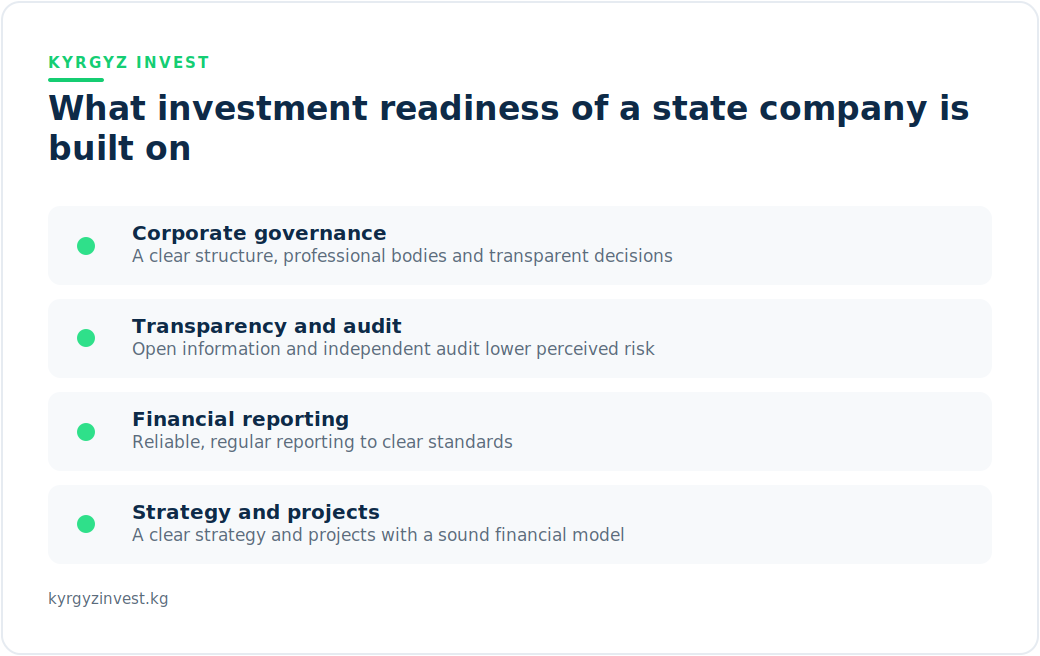
What the investment readiness of a state company is built on
Corporate governance
A clear management structure, a separation of roles, professional governing bodies and transparent decision-making procedures.
Transparency and audit
Openness of information and independent audit raise an investor’s trust and lower perceived risk.
Financial reporting
Reliable, regular reporting to clear standards lets an investor assess the company and the project.
Strategy and projects
A clear development strategy and specific projects that capital is raised for, with a sound financial model.
Mechanisms for attracting investment into the state sector
State assets attract capital in different ways, and the form depends on the task.
- Public-private partnership for infrastructure projects.
- Joint ventures with a private partner.
- Partial privatisation or the sale of a stake while the state keeps control.
- Concessions to operate facilities.
The choice of mechanism determines the distribution of control, risks and returns, and requires careful legal work.
What this gives the investor
For an investor, taking part in projects with state companies means access to large assets and projects, often with state participation and support. At the same time, the quality of corporate governance and the transparency of the specific company directly affect risk. So independent vetting remains essential: we described its logic in the article due diligence explained and the investor guide.
What state companies should work on
These are directions for development, not reproaches. To become more attractive to investors, state companies do well to strengthen transparency and reporting, develop corporate governance, simplify procedures and prepare projects in language an investor understands. These steps build trust and widen the circle of potential partners, including foreign ones. We gave the general context of conditions in the article on the investment climate in Kyrgyzstan.
How to assess a state company or state project
- Transparency of structure and reporting.
- The quality of corporate governance.
- The presence of a strategy and worked-out projects.
- The participation mechanism and the distribution of control.
- The legal basis and guarantees.
- The realism of the financial model.
Frequently asked questions
Why do state companies need private investment?
For modernisation and development when the budget’s capacity is limited, while keeping the state’s control over strategic assets.
What is investment readiness?
It is the degree of a company’s readiness for an investor: transparency, corporate governance, reliable reporting and a clear strategy.
How does the state attract investment?
Through public-private partnership, joint ventures, partial privatisation and concessions.
What are the risks in state projects?
Risk depends on the transparency and governance of the specific company. Independent vetting is essential, and returns are not guaranteed.
How do you assess a state company?
By transparency and reporting, the quality of governance, strategy, the participation mechanism and the realism of the financial model.
Where to go next
If you are considering projects with state participation, take a few steps.
- Study the mechanism: PPP and infrastructure projects and the investment climate.
- Look at the project catalogue and the logic of vetting a project.
- Discuss a specific project: request a diagnostic.