
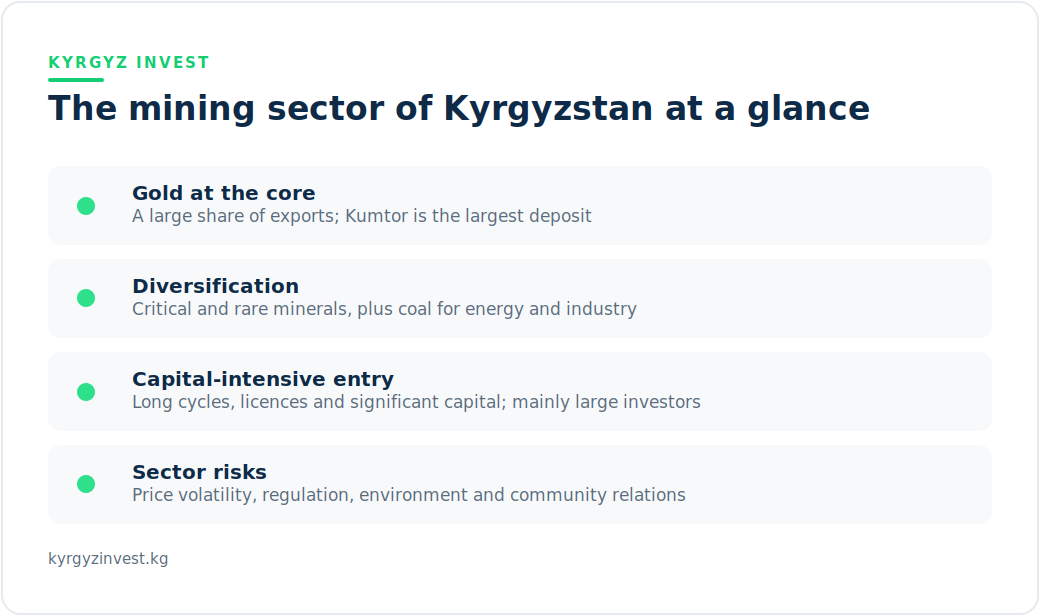
Mining is the historical foundation of Kyrgyzstan’s economy, and its heart is gold. The country’s mineral resources provide a significant part of exports and budget revenue, and development plans are built around the industry, from critical minerals to coal. At the same time, mining is a capital-intensive, long-cycle, risk-sensitive business, accessible mainly to large and strategic investors. In this large study, without political assessments, we look at the role the sector plays in the economy, what it rests on, where it is heading and which risks you will need to account for. The material is for investors, funds and analysts.
The figures below rely on open data from the National Statistical Committee, the relevant ministries and industry reviews. They differ by methodology, for example ore mining and metal smelting are recorded in different sections of the statistics, and they differ by year, so they require checking against current primary sources. We separate facts from conclusions and give no political assessments or commentary on disputes around particular assets. The material is general information and analysis, not investment advice.
The role mining plays in the economy
The mining sector and the metallurgy linked to it provide a notable part of the country’s industrial output, exports and budget revenue. By estimates of the relevant authorities, mining accounts for on the order of 12 percent of GDP and around 46 percent of industrial output, and in recent years it has brought hundreds of billions of som into the budget. An important methodological detail: in the statistics, “ore mining” and “metal production” are recorded separately, so by the narrow definition the share of mining looks more modest, a few percent of GDP, while together with gold smelting the contribution is substantially higher. These figures change and require verification.
Gold as the core of the sector
The basis of the industry is gold. It forms a significant share of the country’s exports: by data for recent periods, the largest destination for gold shipments has been Switzerland, while ores and precious-metal concentrates go to China and Uzbekistan. The largest gold deposits, such as Kumtor, have historically provided the bulk of output. Annual gold production is estimated at around 25 tonnes, and plans to increase it have been announced. Specific volumes and export destinations change from year to year.
Where the industry is heading: diversification
Dependence on a single metal is a risk, so the declared course is diversification. The focus falls on critical and rare minerals, for which global demand is growing, as well as coal as a raw material for energy and industry. The development of processing and geological exploration is seen as a way to raise added value and reduce reliance on raw-material extraction alone. This is a long-term direction that requires investment and technology.
The specifics of investing in mining
Mining is not a retail story. These are capital-intensive projects with a long cycle: years pass from exploration to the start of extraction. The barrier to entry is high; licences, technology and significant capital are needed. So the sector is of interest mainly to large, strategic and institutional investors, as well as specialised funds. For a private investor, direct entry into mining is usually out of reach, but indirect participation is possible through adjacent services, logistics and equipment.
Risks and features of the sector
- Price volatility. Revenue depends on world metal prices.
- Long cycles. Returns are stretched over years.
- Regulatory requirements. Licensing and subsoil-use norms.
- Environment. Environmental requirements and the load on the surroundings.
- Community relations. An important factor in mining areas.
- Geological risk. Actual reserves can differ from estimates.
These are objective features of the industry, not an assessment of particular projects. We wrote about the approach to risk in general in the article on investment risks in Kyrgyzstan. Risk-free income is not guaranteed in mining either.
How to look at a mining project
- Licences and subsoil-use rights.
- Confirmation of reserves: geological data and audit.
- Environmental documentation and approvals.
- Capital costs, the project stage and timelines.
- The sensitivity of the model to the metal price.
- The operator’s experience and community relations.
Sources and a note on the data
The material rests on open data from the National Statistical Committee, the relevant ministries and industry reviews. Shares of GDP, output and export volumes and budget revenue differ by methodology and by year and require checking against current primary sources. Conclusions are separated from facts and are our interpretation; we give no political assessments and do not comment on disputes around particular assets.
Frequently asked questions
What share of the economy does mining take?
Together with metallurgy, on the order of 12 percent of GDP and around half of industrial output; by the narrow classification mining is smaller. The figures require verification.
What is mined in Kyrgyzstan?
Above all gold, as well as coal and ores. A course toward developing critical and rare minerals has been declared.
Where does gold go for export?
By data for recent periods, the largest destination for gold shipments is Switzerland, while precious-metal concentrates go to China and Uzbekistan.
Can a private investor invest in mining?
Direct entry usually requires significant capital and licences, so it is more often the domain of large and institutional investors.
What are the main risks?
Metal prices, long cycles, regulation, the environment and relations with local communities.
Where to go next
If you are studying commodity and industrial directions, a few steps make sense next.
- Look at the catalogue of investment projects.
- Read the related review on the energy sector of Kyrgyzstan.
- Discuss a specific project: request a diagnostic.